
Weitong Composite Leads with Cutting-Edge Woven Roving Technology
Fiberglass fabrics are essential reinforcement materials used in the manufacturing of composite products. By combining glass fibers with resin systems, these materials help improve mechanical strength, stiffness, durability, and impact resistance. Different types of fiberglass fabrics are designed for different manufacturing processes and application requirements.
Among the most commonly used reinforcement materials are fiberglass woven roving, multiaxial fiberglass fabric, and fiberglass stitched mat. Understanding the differences between these materials can help manufacturers select the right reinforcement solution for FRP products, marine structures, wind energy components, automotive parts, and industrial applications.
Fiberglass fabrics are reinforcement materials made by arranging continuous glass fibers into specific structures, which are then combined with resin to create strong composite materials. Unlike traditional materials such as steel or aluminum, fiberglass composites offer excellent strength-to-weight performance, corrosion resistance, and design flexibility.
The structure and fiber orientation of different fiberglass fabric types determine their mechanical properties. Some fabrics are designed for balanced strength, while others provide higher reinforcement in specific directions. Therefore, choosing the right fiberglass fabric depends on the final product requirements, manufacturing process, and performance expectations.
The three common types of fiberglass fabrics include woven roving, multiaxial fabric, and stitched mat, each offering unique advantages for composite manufacturing.
Fiberglass woven roving is one of the most widely used reinforcement materials in composite manufacturing. It is made by weaving continuous glass fiber rovings in a regular pattern, usually with fibers arranged in two directions (0° and 90°). This structure provides balanced strength and good dimensional stability.
Compared with chopped fiber materials, woven roving provides higher mechanical performance because it uses continuous fibers. It also has good compatibility with various resin systems, including polyester, vinyl ester, and epoxy resins.
Thanks to its high strength and excellent processing characteristics, fiberglass woven roving is widely used in composite products requiring structural reinforcement.
Common applications include:
1. Marine vessel manufacturing
2. FRP storage tanks
3. Fiberglass pipes
4. Automotive composite components
5. Construction composites
For large-scale composite structures, woven roving provides excellent tensile strength and impact resistance.
Multiaxial fiberglass fabric is a high-performance reinforcement material made by arranging continuous fibers in multiple directions, such as 0°, 90°, +45°, and -45°. Unlike traditional woven fabrics, the fibers are not woven but are stitched together to maintain their orientation.
This unique structure allows multiaxial fabric to provide better load distribution and higher strength in multiple directions. It can reduce fiber deformation and improve the overall performance of composite products.
Due to their excellent mechanical properties, multiaxial fabrics are widely used in the manufacture of high-performance composites.
Key applications include:
1. Wind turbine blades
2. Marine structural components
3. Lightweight automotive parts
4 . High-performance FRP products
Multiaxial glass fiber fabrics are often an ideal reinforcement choice for products that must withstand complex loads or require lightweight designs.
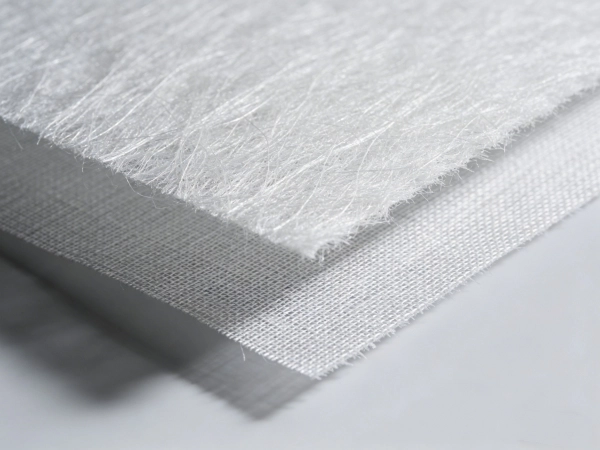
Fiberglass stitched mat is a reinforcement material produced by stitching layers of fiberglass materials together with continuous threads. Compared with traditional mats, stitched mat offers improved structural stability, better thickness control, and enhanced handling performance.
The stitched structure allows the material to maintain its shape during production while providing good resin absorption. It can also be combined with other reinforcement fabrics to create composite materials with improved strength and processing efficiency.
Due to its excellent processability, fiberglass stitched mat is widely used in the manufacture of large-scale FRP products and complex structural components.
Common application areas include:
1. Marine composite components
2. Industrial equipment housings
3. Vehicle parts
4. Composite panels
Stitched mats are suitable for various composite manufacturing processes, such as hand lay-up and vacuum infusion.
Although woven roving, multiaxial fabric, and stitched mat are all used as fiberglass reinforcement materials, they have different structures and performance advantages.
|
Type |
Main Feature |
Typical Applications |
|
Fiberglass woven roving |
Balanced strength, continuous fiber structure, easy handling |
Boats, tanks, pipes, general FRP products |
|
Multiaxial fiberglass fabric |
Multi-directional reinforcement, high strength and stiffness |
Wind blades, marine structures, advanced composites |
|
Fiberglass stitched mat |
Good thickness control, excellent processability |
Large FRP parts, composite panels, industrial products |
Selecting the appropriate fiberglass fabric type depends on factors such as required strength, production method, product size, and final application environment.
When selecting fiberglass fabrics for composite manufacturing, manufacturers should consider both performance requirements and processing conditions.
For general reinforcement applications that require reliable strength and easy processing, fiberglass woven roving is a common choice. For products exposed to higher mechanical loads or requiring multi-directional strength, multiaxial fiberglass fabric can provide better reinforcement performance. When production efficiency, thickness consistency, and handling properties are important, fiberglass stitched mat may be more suitable.
Understanding the characteristics of different fiberglass fabric types helps manufacturers improve composite product quality while reducing production challenges. By selecting the right reinforcement material, companies can achieve better performance, durability, and cost efficiency in their final composite products.