
Weitong Composite Leads with Cutting-Edge Woven Roving Technology
Fiberglass reinforcement plays a critical role in composite manufacturing, repairs, and structural reinforcement. Among the most commonly used materials are fiberglass mat and fiberglass cloth. Although both are made from glass fibers, they serve very different purposes. Knowing when to use fiberglass mat or cloth can significantly impact strength, durability, surface finish, and overall project cost.
This guide breaks down the differences clearly and helps you choose the right fiberglass reinforcement for your application.
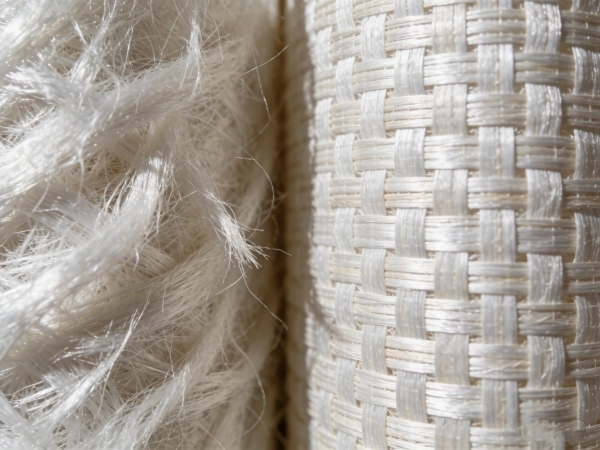
The fundamental difference between fiberglass mat and fiberglass cloth lies in fiber structure and construction.
Fiberglass mat is made from randomly oriented glass fibers bonded together with a binder. This random arrangement gives the mat uniform strength in all directions but relatively lower tensile strength compared to woven materials.
Fiberglass cloth, on the other hand, consists of glass fibers woven into a regular pattern, typically plain weave or twill. The woven structure aligns fibers in specific directions, resulting in higher strength and better load distribution.
• Fiberglass mat = random fibers, bulk reinforcement
• Fiberglass cloth = woven fibers, directional strength
• Understanding this structural difference is the first step in making the right material choice.
Fiber orientation directly influences how a composite handles stress, impact, and long-term loading.
Because fiberglass mat has randomly distributed fibers, it provides:
• Consistent strength in all directions
• Good resistance to cracking and shrinkage
• Lower overall tensile and flexural strength
Fiberglass cloth, with its aligned fiber structure, offers:
• Higher tensile strength and stiffness
• Superior load-bearing capacity
• Better fatigue resistance
This is why fiberglass cloth is often used in structural components, while fiberglass mat is favored for thickness build-up and secondary reinforcement. The fiber structure determines whether the material excels at strength, stability, or dimensional support.
When comparing fiberglass mat vs. fiberglass cloth, performance expectations matter.
In terms of strength, fiberglass cloth clearly outperforms mat. The woven fibers efficiently transfer loads, making cloth ideal for applications where mechanical performance is critical.
In terms of surface finish, fiberglass cloth again has the advantage. Its smooth, uniform weave produces a cleaner surface that requires less sanding or finishing. This makes it a popular choice for visible surfaces, molds, and cosmetic layers.
• Rapid thickness build-up
• Filling complex shapes and contours
• Bonding layers together
As a result, mat is often used beneath cloth layers rather than as a final surface material.
Understanding when to use fiberglass mat or fiberglass cloth depends on application requirements rather than material preference.
• Building thickness quickly is required
• Reinforcing non-structural parts
• Working with complex or curved shapes
• Cost efficiency is a priority
• Using polyester or vinyl ester resin systems
• High strength and stiffness are needed
• Surface appearance is important
• Structural integrity is critical
• Weight control matters
• Precision laminating is required
In many real-world applications, both materials are used together. A common practice is to use fiberglass mat for bulk reinforcement and fiberglass cloth for strength and surface quality.
Choosing the right fiberglass reinforcement involves balancing performance, process, and cost.
• Load requirements and stress direction
• Desired surface finish
• Resin compatibility
• Manufacturing or repair process
• Budget constraints
For heavy-duty structural components, fiberglass cloth is usually indispensable. For repairs, backing layers, or non-load-bearing parts, fiberglass mat often provides sufficient reinforcement at a lower cost. In professional composite fabrication, combining both materials often delivers the best overall performance.
Ultimately, the right choice is not about which material is better, but which material is better suited to your specific application.